
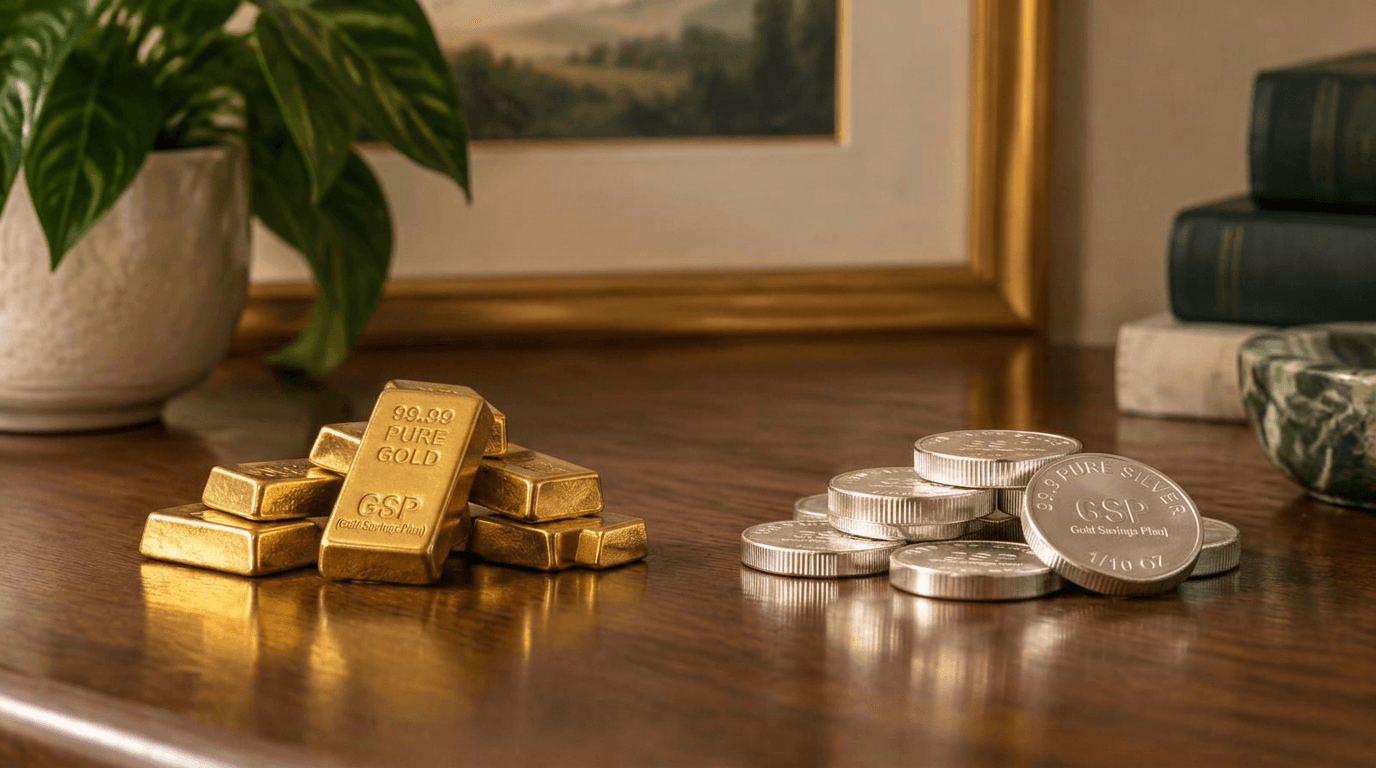
Gold and silver have both been used as physical precious metals for generations, but they are not the same. They differ in price, weight, market characteristics, product formats, and the amount of metal represented by a particular contribution.
For someone considering The Gold Savings Plan™, understanding these differences can help make the choice between gold and silver easier to evaluate.
The Gold Savings Plan™ provides customers with options for both physical gold and silver. Gold can be accumulated in 1/100 troy ounce increments, while silver is available in 1/10 ounce increments.
This guide explains the differences between gold and silver within The Gold Savings Plan™, how the available increments work, what can affect the amount of metal accumulated, and factors to consider when choosing between the two.
Gold and Silver With The Gold Savings Plan™
The Gold Savings Plan™ allows customers to build physical precious metals holdings through recurring contributions.
The plan includes both:
· Gold in 1/100 troy ounce increments
· Silver in 1/10 ounce increments
The choice between the two is ultimately a matter of individual preference, budget, and goals.
Neither metal should automatically be considered the better choice for every customer. Gold and silver have different characteristics, and understanding those characteristics can help you determine which option may fit your preferred approach.
You can review the available products and metal options on the What to Buy page.
What Is the Difference Between Gold and Silver?
The most obvious difference is the amount of metal represented by each unit.
With The Gold Savings Plan™, gold is accumulated in 1/100 troy ounce increments, while silver is accumulated in 1/10 ounce increments.
Gold is also generally priced at a higher value per ounce than silver. This means that a given dollar contribution will typically represent a different quantity of gold than silver.
For example, if the same contribution amount is applied toward gold and silver, the number of ounces represented by the contribution will not be the same.
The important point is that gold and silver should be evaluated based on their individual characteristics rather than simply comparing the number of ounces.
How Gold Works With The Gold Savings Plan™
Gold is available through The Gold Savings Plan™ in 1/100 troy ounce increments.
Because one troy ounce is approximately 31.1 grams, one 1/100 troy ounce increment is approximately 0.311 grams.
This allows customers to build gold holdings in smaller units rather than needing to purchase a full troy ounce at one time.
For example, repeated contributions can gradually accumulate additional gold units.
The quantity of gold represented by each contribution can vary because gold prices change over time.
A fixed contribution therefore does not necessarily purchase exactly the same amount of gold with every transaction.
How Silver Works With The Gold Savings Plan™
Silver is also available through The Gold Savings Plan™, with purchases represented in 1/10 ounce increments.
Because silver generally has a lower price per ounce than gold, a given dollar contribution can represent a different quantity of silver than it would represent in gold.
Silver's lower price per ounce can make it possible for a contribution to represent a larger number of ounces compared with the same contribution toward gold.
However, the number of ounces alone does not determine whether gold or silver is the more appropriate choice. Customers should consider the characteristics of each metal and how they fit their own preferences.
Gold vs. Silver: A Simple Comparison
|
Factor |
Gold |
Silver |
|
Available increment through The Gold Savings Plan™ |
1/100 troy ounce |
1/10 ounce |
|
Approximate weight of one increment |
0.311 grams |
0.1 ounce |
|
Physical metal |
Yes |
Yes |
|
Recurring contributions |
Available |
Available |
|
Value per ounce |
Generally higher than silver |
Generally lower than gold |
|
Price movement |
Can fluctuate |
Can fluctuate |
|
Physical delivery options |
Available subject to applicable requirements |
Available subject to applicable requirements |
|
Best choice for everyone? |
No |
No |
The table provides a basic comparison, but the appropriate choice depends on what you want to accumulate and how you want to structure your physical precious metals holdings.
How Does the Value of Gold Compare With Silver?
Gold generally has a higher value per ounce than silver. As a result, a particular dollar contribution will typically represent a smaller quantity of gold than silver.
For example, a contribution that represents a fraction of a troy ounce of gold may represent multiple ounces of silver, depending on the applicable prices at the time.
This does not mean that silver is automatically a better option because you receive more ounces. An ounce of gold and an ounce of silver represent different metals with different market values.
The more useful question is:
Which metal fits your individual goals, preferences, and savings approach?
How Do Gold and Silver Prices Affect Your Contributions?
The price of both gold and silver can change over time.
This matters because The Gold Savings Plan™ allows customers to make recurring contributions rather than requiring a single large purchase.
Suppose a customer makes the same contribution each month.
If the applicable price of gold changes between two contributions, the amount of gold represented by those contributions may differ.
The same principle applies to silver.
For example:
· A higher applicable metal price can mean a fixed contribution represents a smaller quantity.
· A lower applicable metal price can mean the same contribution represents a larger quantity.
Recurring contributions do not guarantee a specific quantity of metal or a particular outcome.
Is Gold More Stable Than Silver?
Gold and silver can both experience price fluctuations.
Their markets can respond to different economic, industrial, monetary, and market factors. As a result, their prices do not necessarily move by the same amount or in the same direction at every point in time.
It would therefore be inappropriate to describe either metal as guaranteed to be stable or to claim that one will always perform better than the other.
What About Physical Ownership?
An important feature of The Gold Savings Plan™ is that it is designed around physical precious metals holdings.
Customers can accumulate gold or silver in smaller increments and have those holdings stored according to the applicable program terms.
This differs from simply tracking a gold or silver price through a financial product.
The distinction is important for beginners because "owning gold" can refer to different types of products and arrangements.
The Gold Savings Plan™ specifically focuses on physical gold and silver holdings.
Can Gold and Silver Be Delivered as Physical Products?
The Gold Savings Plan™ provides options for converting accumulated holdings into available physical products when applicable requirements are met.
Gold delivery examples can include:
· 1/10 ounce gold coins
· 1 gram gold bars
Silver delivery options are also available in applicable increments.
The exact products available for delivery can depend on current product availability and the applicable terms.
Customers should review the current product information before assuming that a specific product or delivery option will always be available.
Should You Choose Gold or Silver?
There is no universal answer.
The appropriate choice depends on factors such as:
Your Budget
If you are working with a particular recurring contribution amount, consider how that amount translates into gold or silver holdings.
Gold generally represents a higher value per ounce, while silver generally represents a lower value per ounce.
Your Preferred Metal
Some customers may prefer gold because they want to accumulate a smaller physical quantity with a higher value per ounce.
Others may prefer silver because the same contribution can represent a greater number of ounces.
Neither preference is inherently right or wrong.
Your Approach to Fractional Holdings
The Gold Savings Plan™ allows gold to be accumulated in 1/100 troy ounce increments and silver in 1/10 ounce increments.
Understanding these units can help you determine which option fits the way you want to build your holdings.
Your Long-Term Goals
Your personal goals also matter.
Someone interested in gradually building physical gold holdings may approach the choice differently from someone who prefers accumulating silver.
The decision should be based on your own circumstances rather than an assumption that one metal is universally better.
Can You Save in Both Gold and Silver?
The Gold Savings Plan™ includes both gold and silver options.
If you are interested in both metals, you can review the available plan options and determine whether holding both fits your personal preferences and goals.
There is no requirement to make the decision based solely on which metal has the lower price per ounce.
The more useful consideration is how each metal fits into the type of physical precious metals holdings you want to build.
Gold vs. Silver for Beginners
If you are new to physical precious metals, it can help to start with the basic differences rather than trying to predict which metal will perform better.
Consider these questions:
How much do I want to contribute?
Start with a contribution amount that fits your budget.
Do I prefer gold or silver?
Consider which physical metal you are more interested in owning.
Do I understand the available increments?
Gold is available in 1/100 troy ounce increments, while silver is available in 1/10 ounce increments.
Do I understand that prices can change?
Both metals can experience price fluctuations.
Do I understand the delivery and liquidation options?
Review the current terms before making decisions about physical delivery or liquidation.
The Gold Savings Plan™ Tutorial provides additional information for customers who want to understand how the program works.
Gold vs. Silver and Recurring Contributions
Recurring contributions can be useful for customers who prefer a structured approach to building physical precious metals holdings.
With The Gold Savings Plan™, you can establish a contribution schedule and continue accumulating your selected metal over time.
However, recurring contributions should not be confused with guaranteed growth.
The amount of gold or silver accumulated can vary based on the applicable metal price at each contribution.
For example, two identical contributions made at different times may represent different quantities of the selected metal.
This applies to both gold and silver.
What Happens If You Want Physical Delivery?
As your holdings accumulate, you may have the option to convert eligible holdings into available physical products.
The available delivery options depend on the applicable requirements, product availability, and current terms.
The amount of metal accumulated and the physical product you ultimately request are not necessarily the same thing.
For example, accumulated fractional gold units can be converted into an available physical gold product when the applicable requirements are satisfied.
Customers should review the current terms before requesting delivery.
What Happens If You Want to Liquidate?
The Gold Savings Plan™ also provides an option to liquidate all or part of applicable holdings.
Liquidation is generally based on the applicable Bid price at the time of the transaction.
Because gold and silver prices change, the amount received through liquidation may be different from the amount originally contributed.
This applies regardless of whether the customer has chosen gold or silver.
The plan should not be described as guaranteeing a particular return or outcome.
Gold vs. Silver: Key Differences at a Glance
Before making a decision, consider the following:
Gold
· Available in 1/100 troy ounce increments
· Higher value per ounce than silver in typical market conditions
· Smaller quantities can represent significant value
· Available physical delivery options
· Can be accumulated through recurring contributions
Silver
· Available in 1/10 ounce increments
· Generally lower value per ounce than gold
· A contribution can represent a greater number of ounces
· Available physical delivery options
· Can be accumulated through recurring contributions
Both metals:
· Are physical precious metals
· Can fluctuate in price
· Can be accumulated through The Gold Savings Plan™
· Can be subject to applicable storage terms
· May be eligible for physical delivery under applicable requirements
· May be liquidated subject to applicable pricing and terms
How to Decide Between Gold and Silver
Rather than asking which metal is "better," consider which option fits your own buying goals.
A simple decision process is:
1. Determine your preferred contribution amount.
2. Understand the difference between gold and silver prices.
3. Consider whether you prefer gold or silver as a physical metal.
4. Understand the available fractional increments.
5. Review physical delivery options.
6. Review the applicable terms and conditions.
7. Consider whether you want to accumulate one metal or both.
The decision should ultimately be based on your own circumstances and preferences.
Final Thoughts
Gold and silver offer two different ways to build physical precious metals holdings through The Gold Savings Plan™.
Gold is available in 1/100 troy ounce increments, while silver is available in 1/10 ounce increments. Their prices, physical characteristics, and market behavior are different, so the same contribution can represent different quantities of each metal.
There is no universal answer to whether gold or silver is the right choice.
For some customers, gold may fit their preference for a higher-value metal per ounce and smaller fractional units. Others may prefer silver and the larger number of ounces that a particular contribution can represent.
The important step is to understand the differences and choose based on your own budget, preferences, and goals.
If you are considering either option, review the current product information and applicable terms before establishing a plan.
Explore The Gold Savings Plan™
Ready to learn more about the available gold and silver options? Review the current What to Buy information and explore how The Gold Savings Plan™ works.
You can also use the Gold Savings Plan Calculator to explore contribution options and see how different choices may affect the amount of metal represented by your contributions.
FAQs
Is gold or silver better with The Gold Savings Plan™?
Neither metal is universally better. Gold and silver have different characteristics, prices, and available increments. The appropriate choice depends on your individual preferences, budget, and goals.
What is the difference between gold and silver in The Gold Savings Plan™?
Gold is available in 1/100 troy ounce increments, while silver is available in 1/10 ounce increments. Gold generally has a higher value per ounce than silver, although both metal prices can fluctuate.
Can I choose gold and silver?
The Gold Savings Plan™ provides options for both gold and silver. Customers can review the available options and determine which approach fits their preferences.
How much gold is in a 1/100 ounce increment?
One 1/100 troy ounce gold increment is approximately 0.311 grams.
Why does the same contribution buy different amounts of gold or silver?
Gold and silver prices change over time. As a result, the same dollar contribution can represent different quantities of metal at different times.
Can I receive physical gold or silver?
The Gold Savings Plan™ provides options for converting accumulated holdings into available physical products when applicable requirements are met. Current product availability and terms should be reviewed before requesting delivery.
Can I liquidate gold and silver holdings?
Customers may have the option to liquidate all or part of their applicable holdings. Liquidation is generally based on the applicable Bid price at the time of the transaction.
Does choosing silver mean I will always receive more value?
No. Silver generally has a lower value per ounce than gold, so a contribution may represent more ounces of silver. However, the number of ounces should not be confused with the total value of the holdings.
Do gold and silver prices always move together?
No. Gold and silver can respond differently to market and economic conditions, so their prices do not necessarily move by the same amount or in the same direction.
Does The Gold Savings Plan™ guarantee that gold or silver will increase in value?
No. Both gold and silver prices can rise or fall, and the value of accumulated holdings can change. The Gold Savings Plan™ does not guarantee a particular return or outcome.
Internal Links to Add in the CMS
What to Buy: https://www.goldsavingsplan.com/page/what-to-buy
The Gold Savings Plan™ Tutorial: https://www.goldsavingsplan.com/page/tutorial
The Gold Savings Plan™ Calculator: https://www.goldsavingsplan.com/page/gsp-calculator
The Gold Savings Plan™ Terms and Conditions: https://www.goldsavingsplan.com/page/terms-and-conditions